Living in the Hummm…
Teachings from the Bee Deva
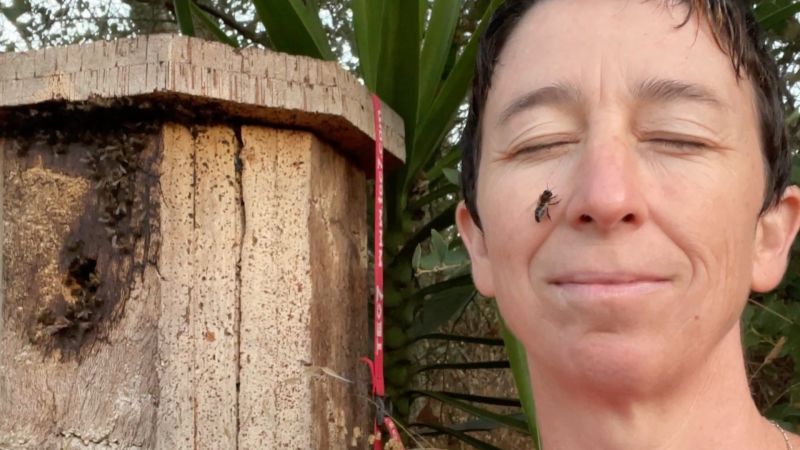
By Sandira Belia
It may sound unusual, but the bees speak to me. I listen to them, and I speak to them in return. The conversations that unfold are sometimes quite astonishing. Their messages are filled with a wide range of information, some of which I have never encountered anywhere else. I call the being with whom I converse the Bee Deva.
Living in the Hummm…
The Bee Deva is a group soul, a collective consciousness. It is not identified with any particular colony, and although it is easier for me to connect with it when I am near a beehive, this is not an essential condition. Our communications take place through various channels, some more physical, others more subtle. Sometimes, the Bee Deva comes to visit me as an energetic presence, invisible to my physical eyes, yet clearly perceptible and tangible to my subtle senses. At other times, it sends me a messenger: a bee that flies around me with a hum of an unusual frequency, or lands on my neck and whispers into my ear.
Our Western way of life has accustomed most of us to maintaining a high level of Beta brainwave activity. High Beta waves are characteristic of what we call “ordinary” thinking: the mind that analyses, reflects, and comments. This constant stream of thoughts clutters our awareness and makes us less receptive to the guidance of the spirits of nature.
Certain practices, such as shamanic journeys, meditation, singing, or dancing, encourage the development of other ranges of brainwave frequencies (particularly Theta waves), which are more conducive to subtle perception. The clutter of the mental space gradually dissolves, opening the way to new dimensions of reality. The Bee Deva calls this state the hummm.
Living in the hummm, in everyday life, means freeing ourselves from the analytical mind’s addiction to judging, weighing, or commenting on every detail of our lives, in order to develop a new relationship with the world: a Soul-to-Soul relationship. The hummm invites trust, simplicity, and a willingness to surrender to allied forces whose understanding extends far beyond the capacities of the rational mind.
The Bee, a Mirror of Our Inner State
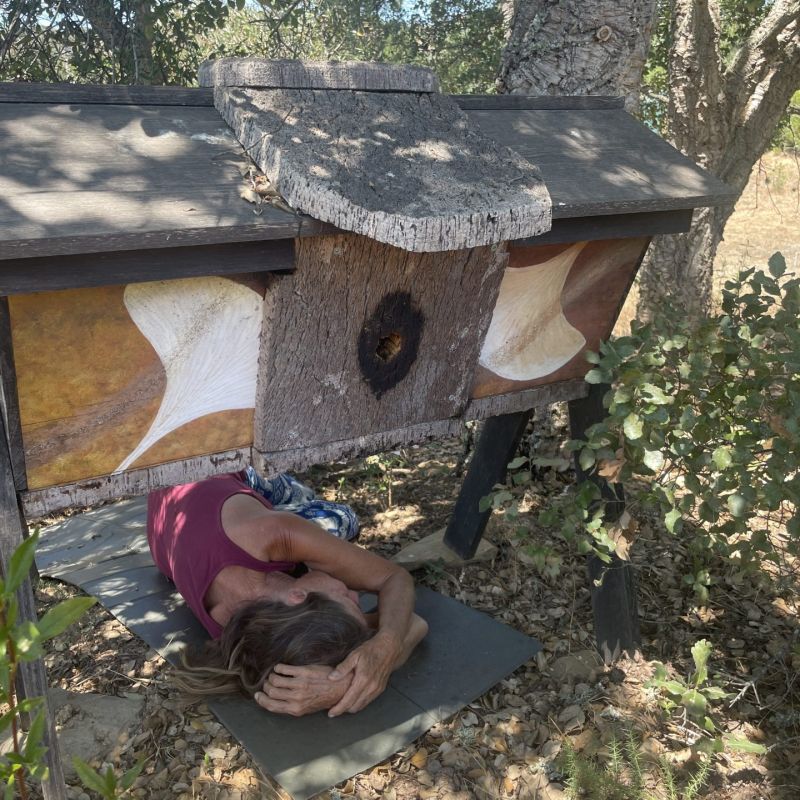
It was springtime. A huge swarm had settled of its own accord into an old swarm trap placed among the rockroses. Given the choice, a swarm will often prefer to move into the weathered body of an old hive rather than a brand-new wooden box. The old hive, worn, darkened, and marked by generations of previous inhabitants, had clearly won its favour.
Together with Annelieke, we wanted to offer the colony a more solid and weatherproof home for the winter, so we decided to transfer it into a beautifully painted new hive. The day was chosen with care: sunny weather, no wind, and the moon in a “root day.“¹
We approached the colony with quiet, gentle steps. Five or six metres from the hive, we paused, asked permission to enter its aura, and expressed our intention. It is only polite to knock before visiting friends, isn’t it? The response came almost immediately: the energetic doorway opened, subtly drawing us forwards. A pleasant feeling of welcome.
I lit the smoker with a blend of dried local plants and a few pieces of propolis. The smoke, with its balsamic fragrance, filled the air and sanctified the space, like incense in an Indian temple. We smudged² one another to cleanse and align our energetic bodies. The smoker was placed beside the hive, releasing its graceful wisps of smoke throughout the entire process.
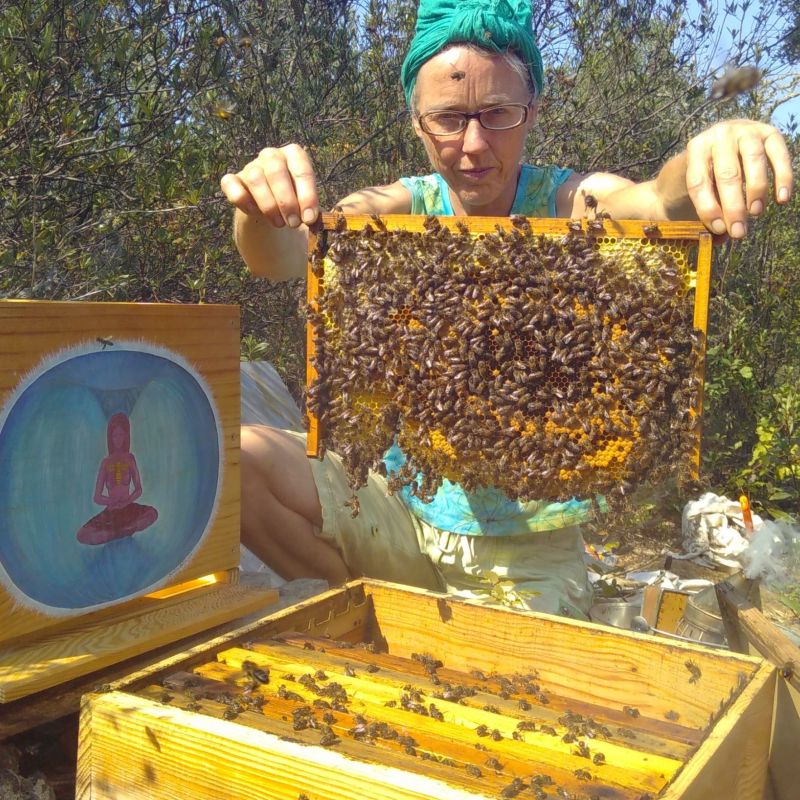
We knew the operation ahead of us was delicate, even surgical, as it involved opening the brood nest. We had brought protective veils in case they were needed, but they remained unnecessary, as we felt so welcomed and accepted.
We moved the old hive from its stand and placed the new hive in exactly the same position. One by one, the frames were carefully transferred into their new home. Moving the outer frames caused no defensive reaction, but as we approached the centre and began handling the brood frames, the tension rose… The hum of the cloud of bees surrounding us became deeper, though never aggressive.
“Be careful,” they seemed to say. “This is our most precious treasure.”
Presence and precision were essential. The slightest abrupt movement could have triggered a massive attack. Yet when the last frame had been transferred and the colony’s new home was closed, the humming gradually softened once again. The thread of trust had remained intact throughout the entire process. A profound sense of mutual respect filled the space.
Once again, I was reminded of how deeply my inner state is reflected in the way the bees respond. Fear and chaotic thoughts are echoed through defensive behaviour. Calm and trust give rise to calm and trust… which, in turn, give rise to more calm and trust… and so the cycle continues.
The Impact of Opening the Brood Nest³
While many conventional beekeepers regard the hive as little more than a machine for producing honey – or pollinating crops – I hold the hope that we may one day come to realise, collectively, that the bee is first and foremost a living being, deserving of gentleness and respect.
I remember an experience from several years ago, during an introductory workshop on organic beekeeping. Halfway through the course, we visited the apiary. Wearing a veil was compulsory, and we were strongly encouraged to wrap several layers of adhesive tape around our wrists and ankles as well.
The beekeeper lifted the roof of the first hive as though opening the bonnet of a car. The moment he removed a brood frame, the colony erupted, enraged by the untimely intrusion of these giant figures dressed like astronauts. A cloud of angry bees descended upon the group gathered around the hive. Hundreds of worker bees lost their stings – and their lives – trying to harpoon the invaders through their thick cotton armour.
Despite the message, expressed so clearly, that we were not welcome, no one moved away, and the instructor calmly continued his demonstration as though nothing had happened. On some faces, I thought I could see a strange expression of power and satisfaction, born from feeling untouchable behind the protective barrier against the furious ladies’ venomous arrows.
That experience strengthened my determination to teach a radically different approach: one based on listening, love, and wholeness, for those seeking a more sensitive relationship with the living world.
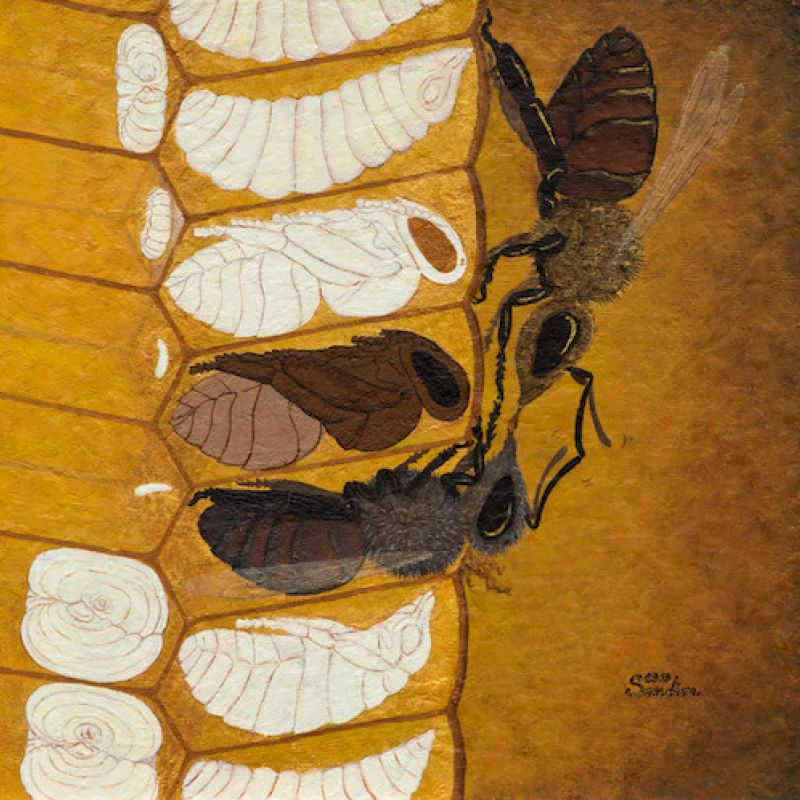
During one of my conversations with the Bee Deva, I received this message concerning the brood nest:
“The nursery is our Grail, the most precious sanctuary of our temple, from which flow the threads that connect us to the Source. Calm, discipline, and purity prevail there. During the laying season, the brood nest is constantly maintained at around 34 to 35°C, a temperature close to that of your own blood, dear humans. Its atmosphere is carefully regulated, its choir skilfully orchestrated.
The opening of the brood nest by a human who is unaware of this precious orchestration is deeply intrusive. Direct sunlight falling upon the brood influences both its development and its learning. It may take us several hours of work, sometimes several days, to restore its atmosphere.
The sacred space of the brood nest is a chamber of gentleness, cradled by the interwoven songs of the nurse bees and the drones. Their songs carry the subtle teachings required for the initiation of the generations yet to be born. The ladies sing of the present: the scent of flowers, the curve of the horizon, the temperature of the wind, and the essence of the tasks that earthly life holds for them. The drones, for their part, are storytellers. They sing of the past and the future, the whisper of the ancestors, and the covenant that binds us to humanity. The songs of male and female blend into a perfect symphony, at once celestial and earthly, a lullaby accompanying our young through their process of incarnation.”